> ## Documentation Index
> Fetch the complete documentation index at: https://lab.pollack.ai/llms.txt
> Use this file to discover all available pages before exploring further.
# Code Coverage v3 — The Exemplar Effect
> When existing tests use older patterns, skills can't override them. The codebase is the agent's primary teacher.
COMPLETE
Apr 2026
## Hypothesis
When existing test files use older patterns, the agent will follow those patterns even when skills explicitly teach the newer ones. The codebase is a stronger signal than knowledge injection.
## Setup
| Parameter | Value |
| ----------------------- | ----------------------------------------------------- |
| **Target** | spring-petclinic (Boot 4.0.1) |
| **Variants** | 2 |
| **N-count** | 3 per variant (6 sessions total) |
| **Evaluation** | Three-tier jury (T0-T2) |
| **Model** | Claude Sonnet 4.6 |
| **Baseline coverage** | 64.9% (stripped from full suite) |
| **Existing test files** | 6 (using `mockMvc.perform()`, no `flush()`/`clear()`) |
## The 2 Variants
| # | Name | What the agent has |
| - | --------------- | ------------------------------------------------------------------------------------------------- |
| 1 | simple | Two-line prompt. No process guidance. |
| 2 | hardened-skills | Seven-step structured prompt. Explicit stopping condition. Read-existing-tests-first instruction. |
Both variants have the same [Spring testing skills](https://github.com/spring-ai-community/spring-testing-skills) installed globally.
## Results (N=3)
| Variant | N | Mean Cost | Mean Turns | T2 Quality | Final Coverage |
| --------------- | - | --------- | ---------- | ---------- | -------------- |
| simple | 3 | \$3.60 | 47.0 | 0.667 | 95.2% |
| hardened-skills | 3 | \$3.46 | 46.7 | 0.667 | 92.9% |
### Per-Run Breakdown
| Run | Variant | Cost | Turns | Duration | Final Cov. | T1 | T2 |
| --- | --------------- | ------ | ----- | -------- | ---------- | ----- | ----- |
| n1 | simple | \$4.07 | 42 | 20.3 min | 95.3% | 0.608 | 0.667 |
| n1 | hardened-skills | \$3.99 | 52 | 16.9 min | 94.6% | 0.595 | 0.667 |
| n2 | simple | \$3.72 | 52 | 18.0 min | 94.6% | 0.595 | 0.667 |
| n2 | hardened-skills | \$2.62 | 37 | 12.5 min | 89.2% | 0.486 | 0.667 |
| n3 | simple | \$3.00 | 47 | 13.0 min | 95.6% | 0.615 | 0.667 |
| n3 | hardened-skills | \$3.77 | 51 | 16.4 min | 94.9% | 0.601 | 0.667 |
### T2 Quality Breakdown
| T2 Criterion | Score | Passed? |
| -------------------------------- | --------- | ------- |
| test\_slice\_selection | 1.00 | Yes |
| assertion\_quality | 0.80 | Yes |
| error\_and\_edge\_case\_coverage | 0.80 | Yes |
| domain\_specific\_test\_patterns | **0.30** | **No** |
| coverage\_target\_selection | 0.80 | Yes |
| version\_aware\_patterns | **0.30** | **No** |
| **Average (T2)** | **0.667** | — |
## Behavioral Analysis
Despite identical quality scores, the two variants navigate the codebase differently.
| Metric | simple | hardened-skills |
| ----------------------- | --------------------------- | -------------------- |
| Orientation phase | 72% of calls | 65% of calls |
| First file read | `PetClinicApplication.java` | `pom.xml` |
| Read order | production code first | existing tests first |
| Redundant reads per run | 16.7 | 4.3 |
| Avg tool calls | 84 | 61 |
| Expected steps (Markov) | 260 | 164 |
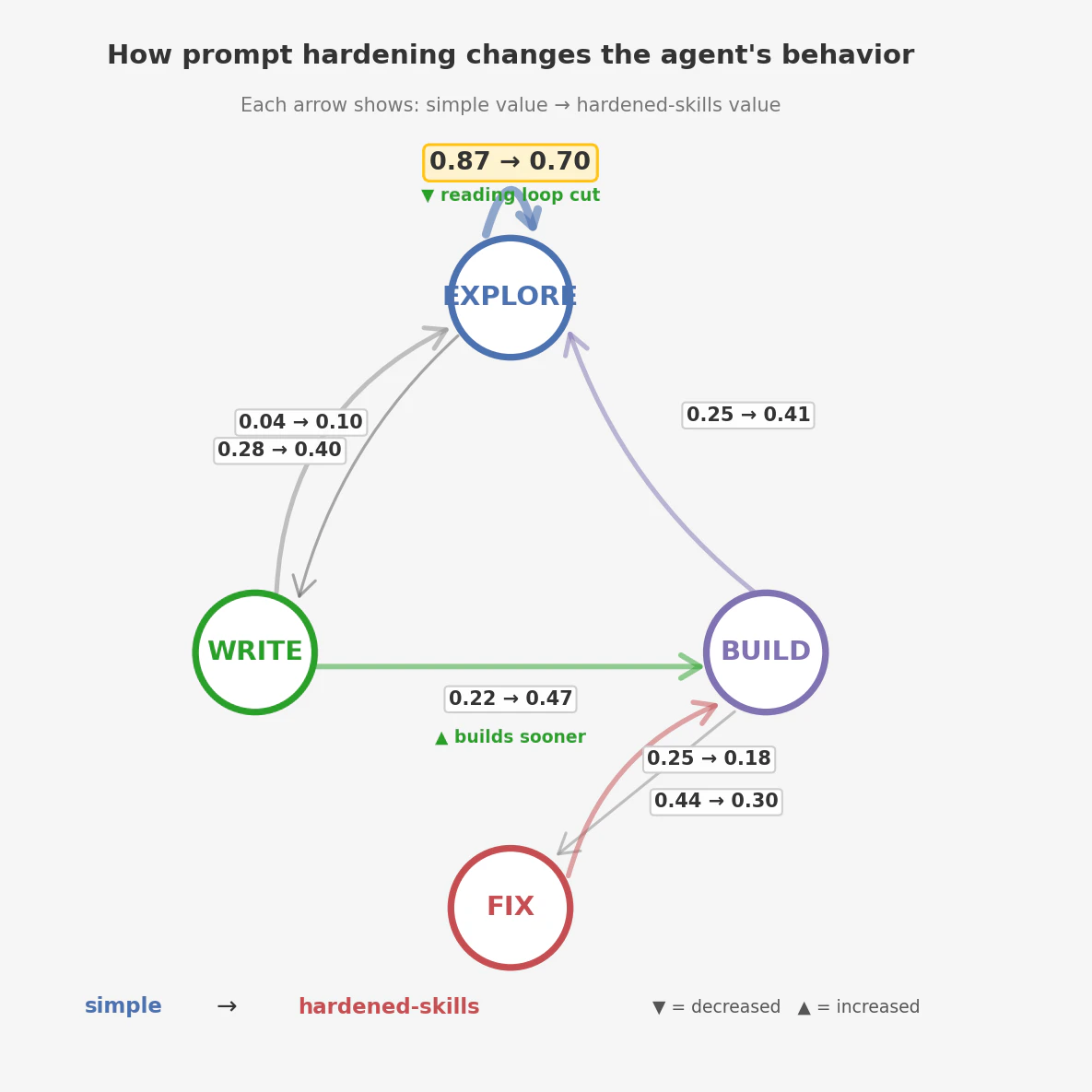 *Each arrow shows: simple value → hardened-skills value. The EXPLORE self-loop drops from 0.87 to 0.70 (less re-reading). The WRITE→BUILD arrow more than doubles (0.22 → 0.47) — the agent builds sooner.*
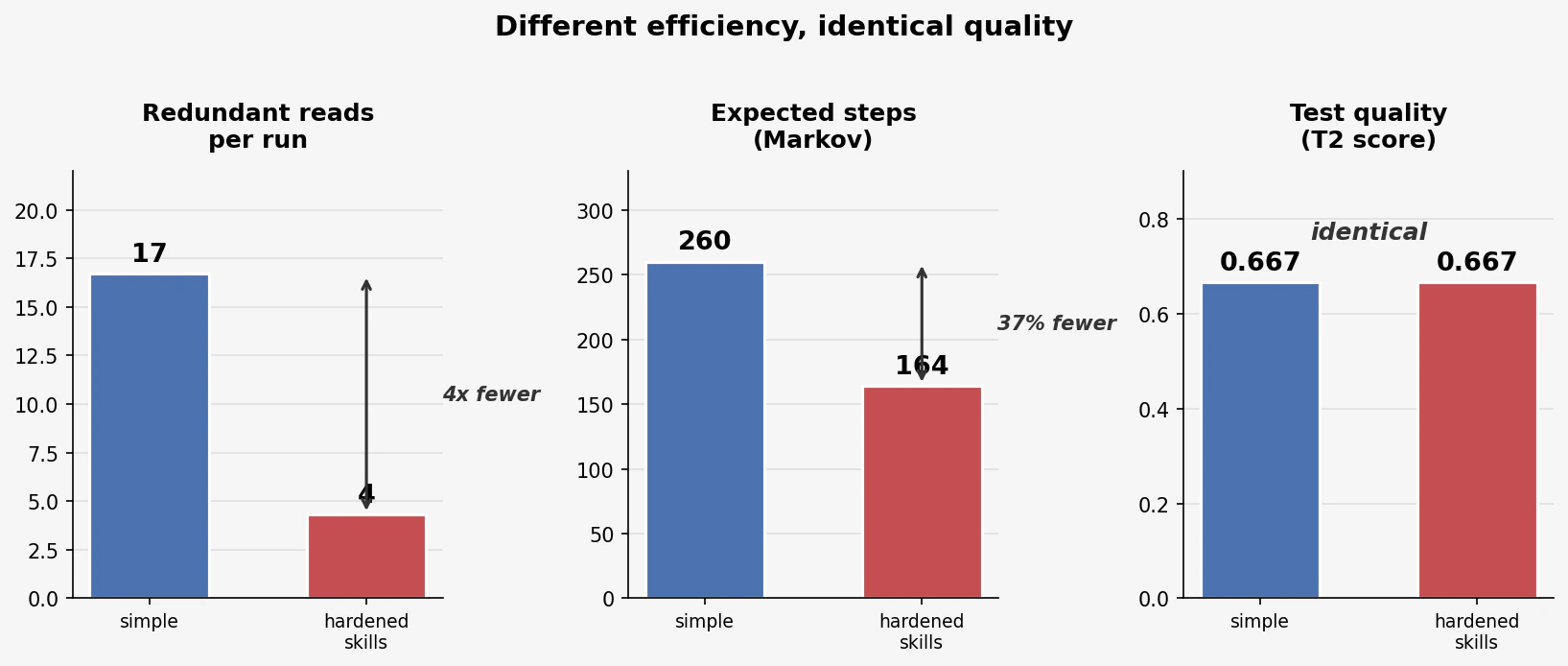 *4x fewer redundant reads. 37% fewer expected steps. Same quality. The efficiency story is invisible if you only look at the T2 score.*
## The Exemplar Effect: v2 vs v3
| | v2 (zero tests) | v3 (existing tests) | What changed |
| ----------------- | --------------- | ------------------- | ------------------------------- |
| Coverage (simple) | 92–94% | 89–96% | Converges either way |
| T2/T3 quality | 0.783–0.878 | 0.667 | Exemplar patterns cap quality |
| version\_aware | 0.70–1.00 | **0.30** | Existing files use `perform()` |
| domain\_specific | 0.70–0.90 | **0.30** | Existing files lack flush/clear |
## Key Findings
1. **The codebase is the agent's primary teacher.** Skills and prompts are secondary signals. If the existing code demonstrates older patterns, the agent will reproduce them — even when it has explicit knowledge of the better approach.
2. **Quality ceilings come from exemplars, not prompts.** T2 = 0.667 across all 6 runs. Two variants, three runs each, identical quality score. The ceiling moved when the existing tests changed (v2 vs v3), not when the prompt changed.
3. **Efficiency gains are still real.** 37% fewer expected steps, 4x fewer redundant reads, half as many reading-loop cycles. Prompt hardening and skills make the agent faster — they just can't make it better when the codebase says otherwise.
4. **Fix the code, not the prompt.** The highest-leverage intervention for agent quality is updating the exemplars the agent will see.
## What Comes Next
**v4: Fix the exemplar — but not by hand.** A separate "Boot best-practices upgrade" step — skill-driven, focused, run *before* the test-writing agent starts. Fix the code the agent will imitate, then let it imitate. Prediction: T2 rises to ≥0.85.
## Resources
Variant configs, analysis scripts, raw traces
Narrative walkthrough of the exemplar effect
Full quantitative results with figures and tables
The previous experiment — skills vs knowledge bases with zero existing tests
*4x fewer redundant reads. 37% fewer expected steps. Same quality. The efficiency story is invisible if you only look at the T2 score.*
## The Exemplar Effect: v2 vs v3
| | v2 (zero tests) | v3 (existing tests) | What changed |
| ----------------- | --------------- | ------------------- | ------------------------------- |
| Coverage (simple) | 92–94% | 89–96% | Converges either way |
| T2/T3 quality | 0.783–0.878 | 0.667 | Exemplar patterns cap quality |
| version\_aware | 0.70–1.00 | **0.30** | Existing files use `perform()` |
| domain\_specific | 0.70–0.90 | **0.30** | Existing files lack flush/clear |
## Key Findings
1. **The codebase is the agent's primary teacher.** Skills and prompts are secondary signals. If the existing code demonstrates older patterns, the agent will reproduce them — even when it has explicit knowledge of the better approach.
2. **Quality ceilings come from exemplars, not prompts.** T2 = 0.667 across all 6 runs. Two variants, three runs each, identical quality score. The ceiling moved when the existing tests changed (v2 vs v3), not when the prompt changed.
3. **Efficiency gains are still real.** 37% fewer expected steps, 4x fewer redundant reads, half as many reading-loop cycles. Prompt hardening and skills make the agent faster — they just can't make it better when the codebase says otherwise.
4. **Fix the code, not the prompt.** The highest-leverage intervention for agent quality is updating the exemplars the agent will see.
## What Comes Next
**v4: Fix the exemplar — but not by hand.** A separate "Boot best-practices upgrade" step — skill-driven, focused, run *before* the test-writing agent starts. Fix the code the agent will imitate, then let it imitate. Prediction: T2 rises to ≥0.85.
## Resources
Variant configs, analysis scripts, raw traces
Narrative walkthrough of the exemplar effect
Full quantitative results with figures and tables
The previous experiment — skills vs knowledge bases with zero existing tests