> ## Documentation Index
> Fetch the complete documentation index at: https://lab.pollack.ai/llms.txt
> Use this file to discover all available pages before exploring further.
# Code Coverage v2 — Skills vs Knowledge Bases
> 7 variants on Spring PetClinic testing whether structured skills outperform flat knowledge injection
COMPLETE
Mar 2026
## Hypothesis
Structured skills (SkillsJars) outperform flat knowledge injection — not because they contain more knowledge, but because structure itself changes agent behavior. Pre-analysis (a mandatory exploration pass before writing code) further reduces wasted steps by front-loading understanding.
## Setup
| Parameter | Value |
| --------------------- | ------------------------------------------ |
| **Target** | spring-petclinic (Boot 4.0.1) |
| **Variants** | 7 |
| **N-count** | 3 per variant (20 sessions total) |
| **Evaluation** | Four-tier jury (T0-T3) |
| **Model** | Claude Sonnet 4 |
| **Agent engine** | [Agent Workflow](/projects/agent-workflow) |
| **Starting coverage** | 0% (all tests deleted) |
## The 7 Variants
Each variant adds one variable on top of the previous. This isolates the effect of each intervention.
| # | Name | What it adds |
| - | ------------------------------------ | ------------------------------------------------------------------- |
| 1 | simple | Minimal prompt, no knowledge, no stopping condition |
| 2 | hardened | Structured prompt + explicit stopping condition |
| 3 | hardened+kb | Hardened + flat knowledge base (Spring test imports, JaCoCo config) |
| 4 | hardened+skills | Hardened + SkillsJars (structured, modular knowledge packages) |
| 5 | hardened+preanalysis | Hardened + mandatory pre-analysis pass before writing tests |
| 6 | hardened+skills+preanalysis | Skills + pre-analysis together |
| 7 | hardened+skills+preanalysis+plan-act | Two-phase: deep exploration then sustained action |
## Results (N=3)
| Variant | Mean Steps | Mean Cost | T3 Quality |
| ------------------------------------ | ---------- | --------- | ---------- |
| hardened+skills+preanalysis | 75.0 | \$3.39 | 0.850 |
| hardened+preanalysis | 80.3 | \$3.41 | 0.789 |
| hardened+kb | 83.3 | \$3.21 | 0.847 |
| hardened+skills+preanalysis+plan-act | 95.0 | \$5.11 | 0.878 |
| hardened+skills | 101.7 | \$3.70 | 0.856 |
| hardened | 103.0 | \$4.08 | 0.850 |
| simple | 109.5 | \$3.47 | 0.783 |
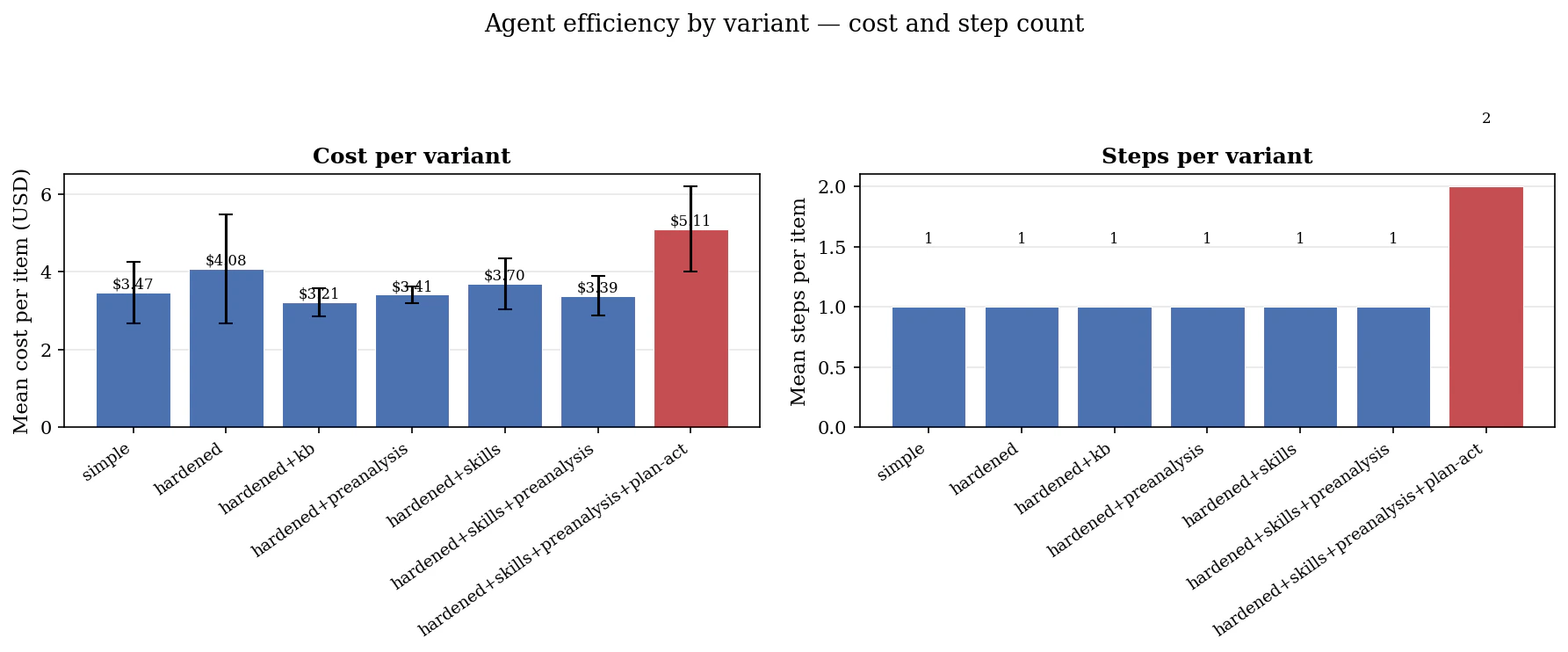 *Cost and step count across 7 variants. Skills+preanalysis (variant 6) achieves the lowest step count without inflating cost. Plan-act (variant 7) pays \$5.11 for marginal quality gain.*
## Key Findings
### 1. Prompt hardening is the biggest quality driver
simple → hardened: +0.067 quality, -6% steps. A free gain from structural discipline alone — no knowledge injection, just telling the agent when to stop and how to structure its work.
### 2. Pre-analysis drives efficiency at a quality cost
hardened+preanalysis: -22% steps but quality drops to 0.789. The agent follows its pre-analysis plan too rigidly, missing edge cases it would have discovered through exploration. Same attention budget, worse allocation.
### 3. Skills fix pre-analysis's quality regression
hardened+skills+preanalysis: -31% steps AND quality = 0.850 (matches hardened). Skills give the agent the right vocabulary for each step, so it doesn't waste attention discovering patterns. Best tradeoff in the experiment.
### 4. KB is a pure efficiency play on known codebases
hardened+kb: -24% steps, quality flat. The knowledge base eliminates JAR inspection cycles (the agent no longer needs to discover Spring Boot 4 import changes). On novel codebases the effect should be larger.
### 5. Plan-act is high variance
Highest quality ceiling (0.878) but also highest cost (\$5.11) and rework spiral risk. The two-phase approach (deep exploration then sustained writing) occasionally gets stuck in fix loops.
### 6. Markov model predicts step counts
Zero mean bias in leave-one-out cross-validation despite formal rejection of the first-order assumption. The model is wrong in theory but useful in practice.
## Behavioral Analysis
Every tool call across all 20 sessions was classified into one of 9 behavioral states using the [Markov fingerprinting](/methodology/markov-fingerprinting) methodology. This reveals *how* variants differ, not just *whether* they produce different outcomes.
### Transition Probability Matrix
*Cost and step count across 7 variants. Skills+preanalysis (variant 6) achieves the lowest step count without inflating cost. Plan-act (variant 7) pays \$5.11 for marginal quality gain.*
## Key Findings
### 1. Prompt hardening is the biggest quality driver
simple → hardened: +0.067 quality, -6% steps. A free gain from structural discipline alone — no knowledge injection, just telling the agent when to stop and how to structure its work.
### 2. Pre-analysis drives efficiency at a quality cost
hardened+preanalysis: -22% steps but quality drops to 0.789. The agent follows its pre-analysis plan too rigidly, missing edge cases it would have discovered through exploration. Same attention budget, worse allocation.
### 3. Skills fix pre-analysis's quality regression
hardened+skills+preanalysis: -31% steps AND quality = 0.850 (matches hardened). Skills give the agent the right vocabulary for each step, so it doesn't waste attention discovering patterns. Best tradeoff in the experiment.
### 4. KB is a pure efficiency play on known codebases
hardened+kb: -24% steps, quality flat. The knowledge base eliminates JAR inspection cycles (the agent no longer needs to discover Spring Boot 4 import changes). On novel codebases the effect should be larger.
### 5. Plan-act is high variance
Highest quality ceiling (0.878) but also highest cost (\$5.11) and rework spiral risk. The two-phase approach (deep exploration then sustained writing) occasionally gets stuck in fix loops.
### 6. Markov model predicts step counts
Zero mean bias in leave-one-out cross-validation despite formal rejection of the first-order assumption. The model is wrong in theory but useful in practice.
## Behavioral Analysis
Every tool call across all 20 sessions was classified into one of 9 behavioral states using the [Markov fingerprinting](/methodology/markov-fingerprinting) methodology. This reveals *how* variants differ, not just *whether* they produce different outcomes.
### Transition Probability Matrix
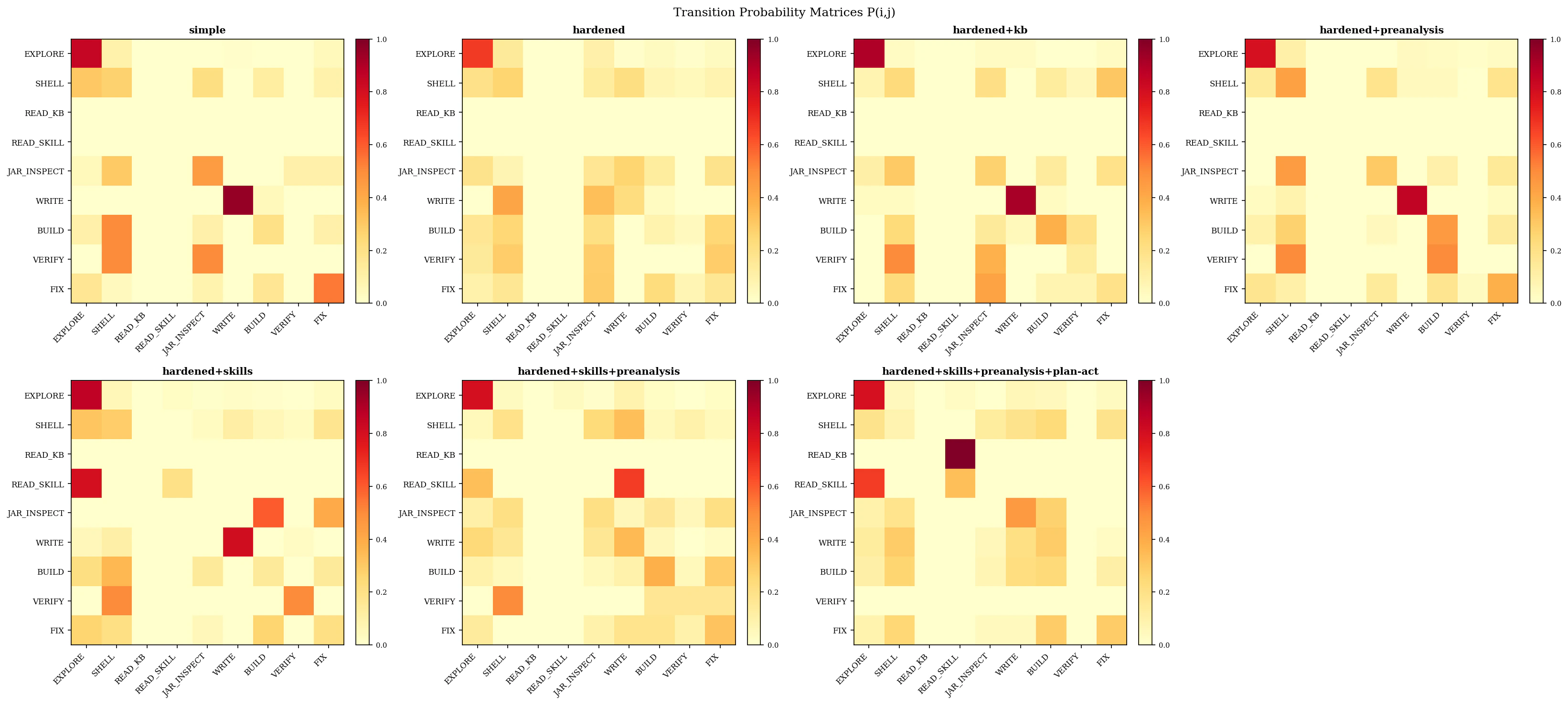 *Each cell shows the probability of transitioning from one behavioral state to another. Darker cells = higher probability. The diagonal (self-loops) dominates — agents spend most time repeating the same type of action.*
### The JAR Cluster: Knowledge Friction
The most distinctive behavioral signature was the JAR\_INSPECT cluster — the agent downloading and inspecting Spring Boot JARs to discover import paths that changed between Boot 3 and Boot 4.
*Each cell shows the probability of transitioning from one behavioral state to another. Darker cells = higher probability. The diagonal (self-loops) dominates — agents spend most time repeating the same type of action.*
### The JAR Cluster: Knowledge Friction
The most distinctive behavioral signature was the JAR\_INSPECT cluster — the agent downloading and inspecting Spring Boot JARs to discover import paths that changed between Boot 3 and Boot 4.
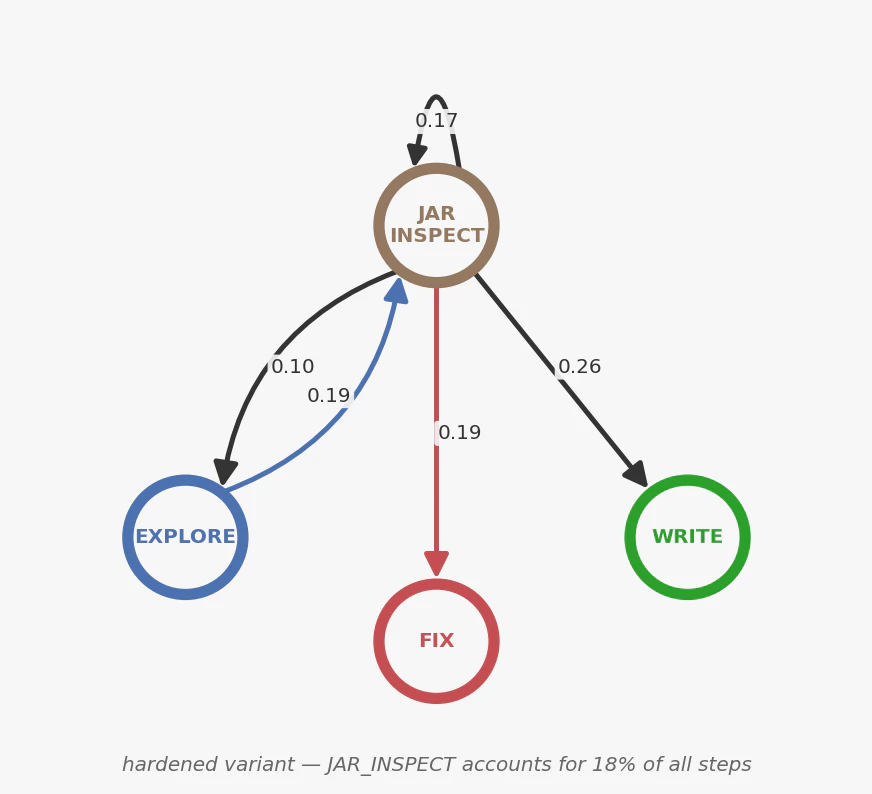 *Without knowledge injection, the agent cycles through JAR inspection trying to discover Boot 4 import changes. This loop consumed 6–18% of all tool calls in variants without KB or skills.*
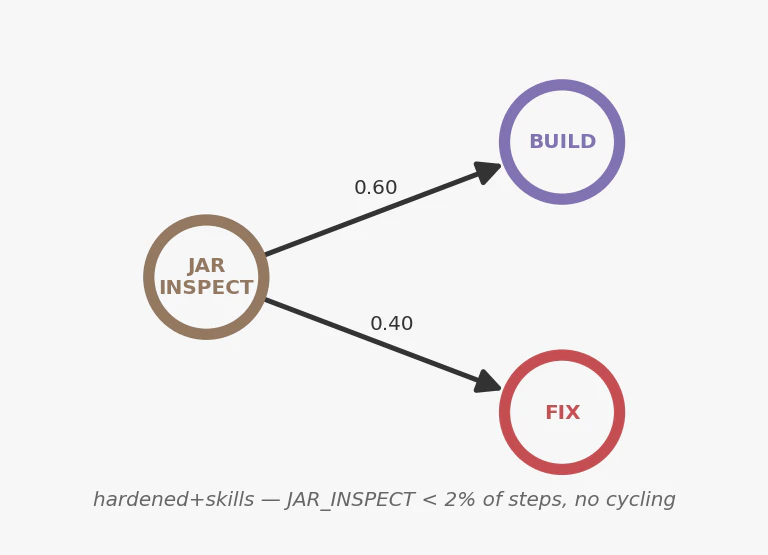 *With skills or KB providing the correct imports, the JAR inspection loop disappears entirely. The agent goes straight from reading to writing.*
### Loop Amplification
*With skills or KB providing the correct imports, the JAR inspection loop disappears entirely. The agent goes straight from reading to writing.*
### Loop Amplification
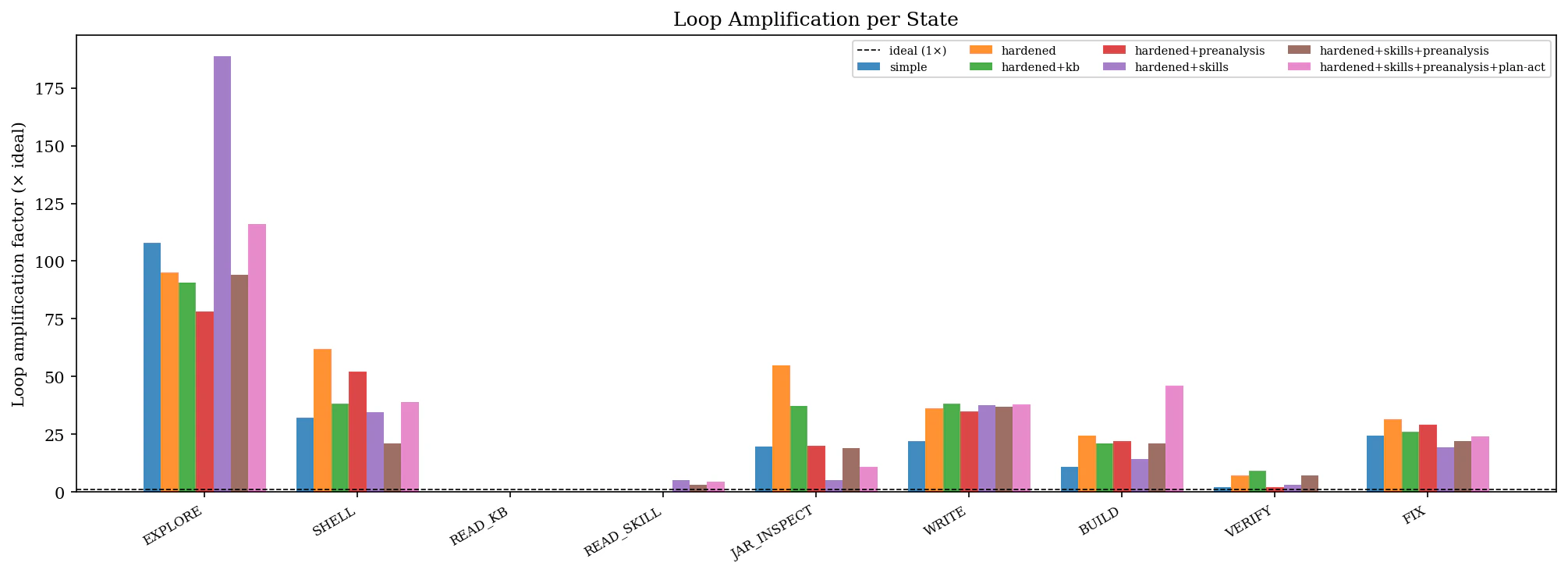 *The Markov fundamental matrix predicts how many times the agent cycles through each loop before absorbing. Skills+preanalysis cuts the EXPLORE loop from 189 expected cycles to 93 — same attention budget, better allocation.*
### Intervention Deltas
*The Markov fundamental matrix predicts how many times the agent cycles through each loop before absorbing. Skills+preanalysis cuts the EXPLORE loop from 189 expected cycles to 93 — same attention budget, better allocation.*
### Intervention Deltas
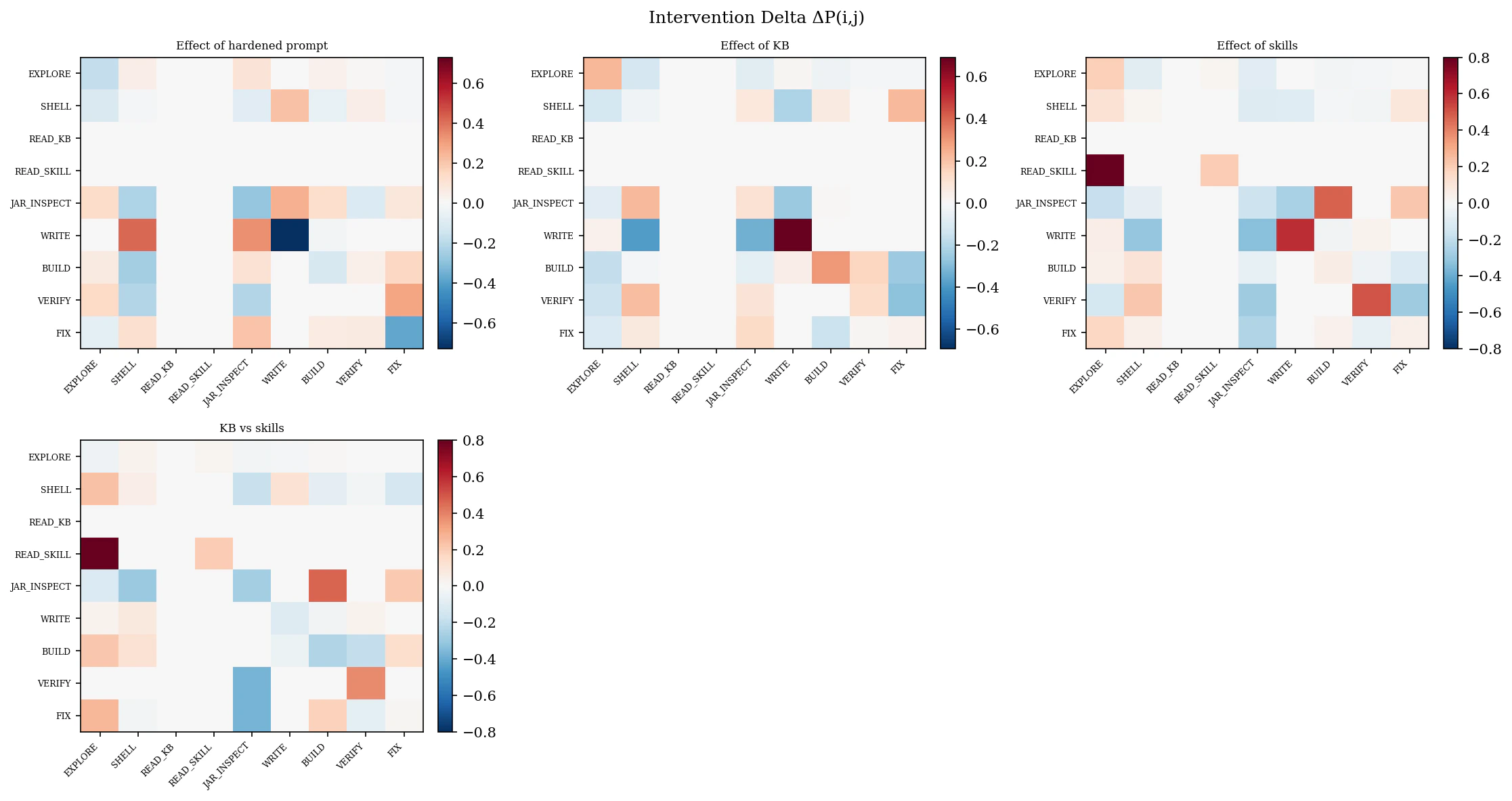 *Each panel shows the change in transition probabilities when adding one intervention. Red = increased probability, blue = decreased. Skills most visibly reduce the EXPLORE self-loop and increase WRITE→BUILD transitions.*
### Sankey Flow Comparison
*Each panel shows the change in transition probabilities when adding one intervention. Red = increased probability, blue = decreased. Skills most visibly reduce the EXPLORE self-loop and increase WRITE→BUILD transitions.*
### Sankey Flow Comparison
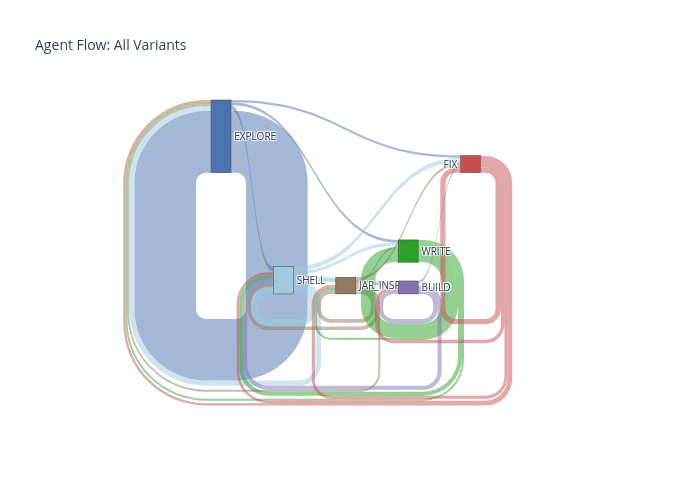 *Tool-call flow from left to right. The simple variant (top) shows wide, diffuse flows through many states. The skills+preanalysis variant (bottom) is narrower and more directed — fewer detours, more time writing.*
### Behavioral Heatmaps
*Tool-call flow from left to right. The simple variant (top) shows wide, diffuse flows through many states. The skills+preanalysis variant (bottom) is narrower and more directed — fewer detours, more time writing.*
### Behavioral Heatmaps
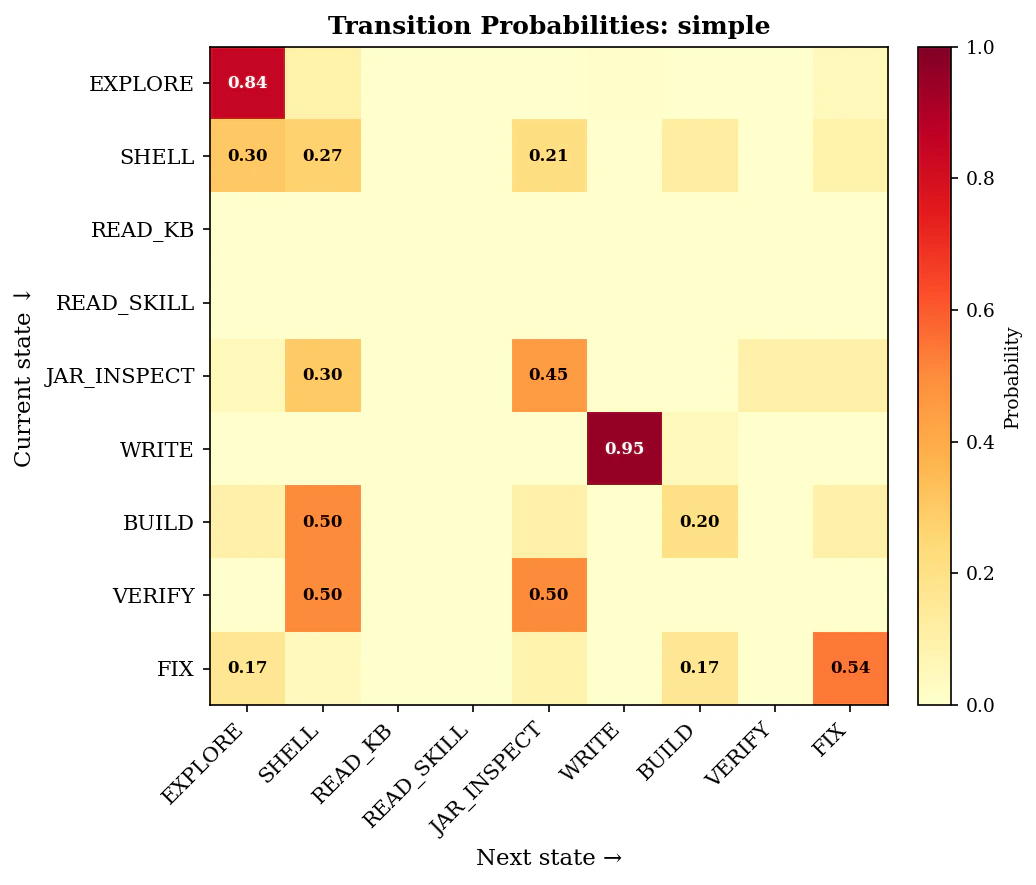 *Simple variant: broad exploration, scattered writes, high JAR\_INSPECT activity. The agent discovers everything through trial and error.*
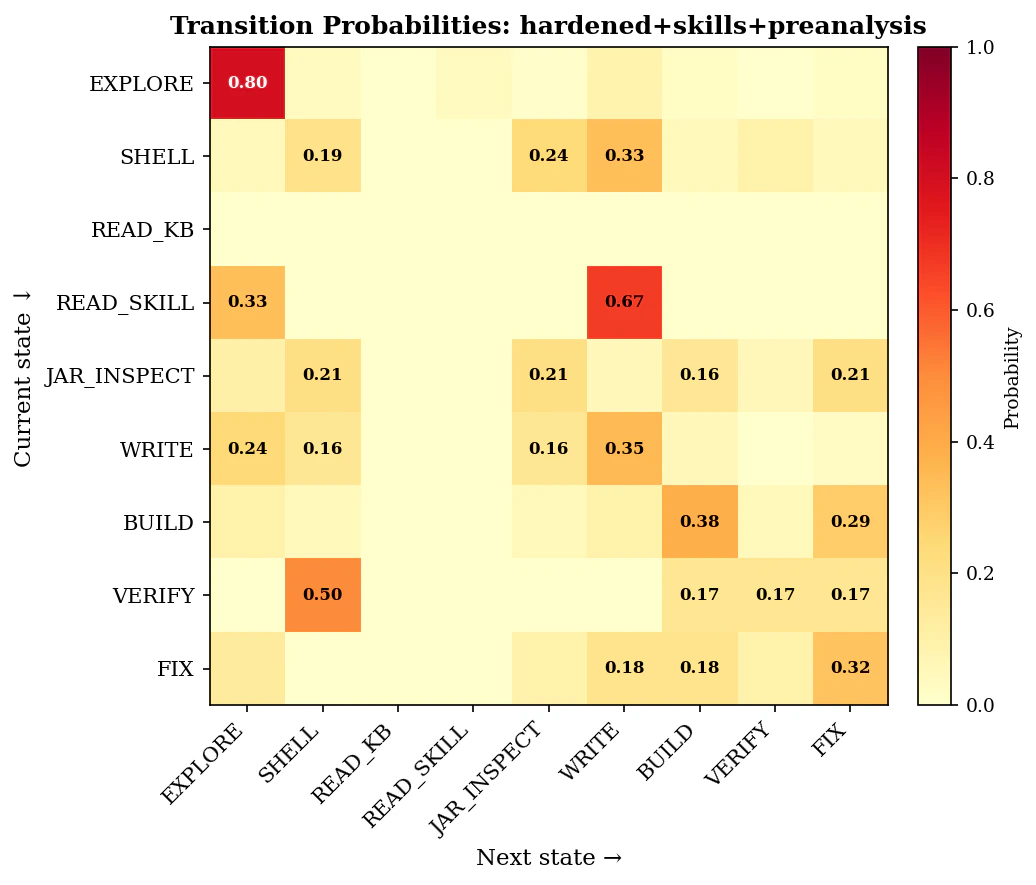 *Skills+preanalysis: focused exploration phase, then sustained writing. JAR\_INSPECT is eliminated. The agent knows what it needs and writes it.*
## What Comes Next
The follow-up experiment ([Code Coverage v3](/experiments/code-coverage-v3)) tests what happens when the agent has skills but the existing codebase demonstrates older patterns. Spoiler: the codebase wins.
## Resources
Full dataset download, variant configs, raw traces
Narrative walkthrough of the behavioral analysis
Full quantitative results with figures and tables
How to read agent behavioral traces — a casual explainer
The first experiment establishing the methodology
What happens when existing code contradicts skill guidance
*Skills+preanalysis: focused exploration phase, then sustained writing. JAR\_INSPECT is eliminated. The agent knows what it needs and writes it.*
## What Comes Next
The follow-up experiment ([Code Coverage v3](/experiments/code-coverage-v3)) tests what happens when the agent has skills but the existing codebase demonstrates older patterns. Spoiler: the codebase wins.
## Resources
Full dataset download, variant configs, raw traces
Narrative walkthrough of the behavioral analysis
Full quantitative results with figures and tables
How to read agent behavioral traces — a casual explainer
The first experiment establishing the methodology
What happens when existing code contradicts skill guidance